
Introduction: Why Rod Mills Deserve a Second Look
In the world of mineral processing and industrial grinding, the ball mill often steals the spotlight. But for many applications—particularly coarse grinding, sand making, and gravity separation—the rod mill is the unsung hero that delivers superior results with lower operating costs.
If you've ever struggled with excessive fines (slimes) hurting your recovery rates, or if you need a consistent, uniform particle size distribution without over-grinding, the rod mill might be exactly what your circuit is missing.
What Is a Rod Mill?
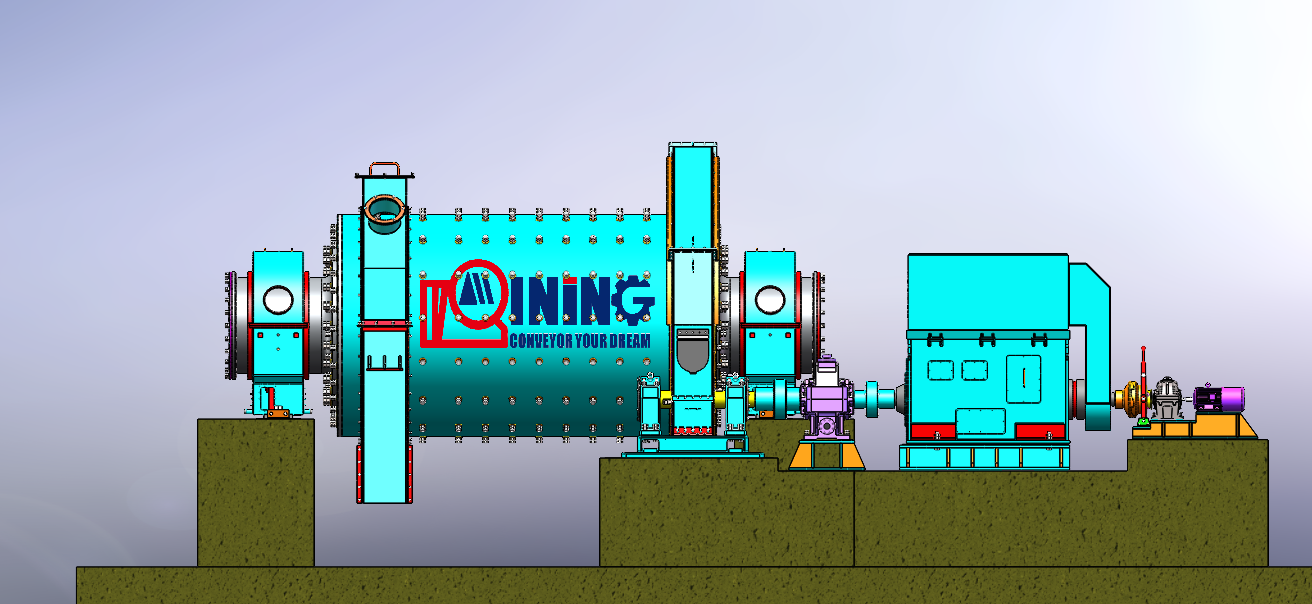
A rod mill is a rotating cylindrical mill that uses long steel rods as the grinding medium. These rods, typically about the same length as the mill cylinder, are charged into the mill alongside the ore. As the mill rotates, the rods cascade and tumble, crushing the ore through a combination of impact, compression, and attrition.
Unlike ball mills that rely on steel balls, rod mills use line contact between the rods and ore particles. This fundamental difference—point contact versus line contact—creates entirely different grinding outcomes.
How Rod Mills Work: The Principle
The working principle of a rod mill is straightforward but highly effective:
Feed enters the mill through the feed end, where a conical or convex head creates a receiving pocket that facilitates uniform feed distribution.
The mill rotates at 50% to 65% of its critical speed—slower than a ball mill, so the rods cascade rather than cataract.
Rods grind the ore through line contact, crushing larger particles while protecting smaller ones from over-grinding.
Product discharges through overflow-type or open-type discharge—rod mills do not use grate discharge.
The result is a uniform, narrow particle size distribution with minimal fines.
Why Rod Mills Excel: Key Advantages
1. Selective Grinding with Minimal Fines
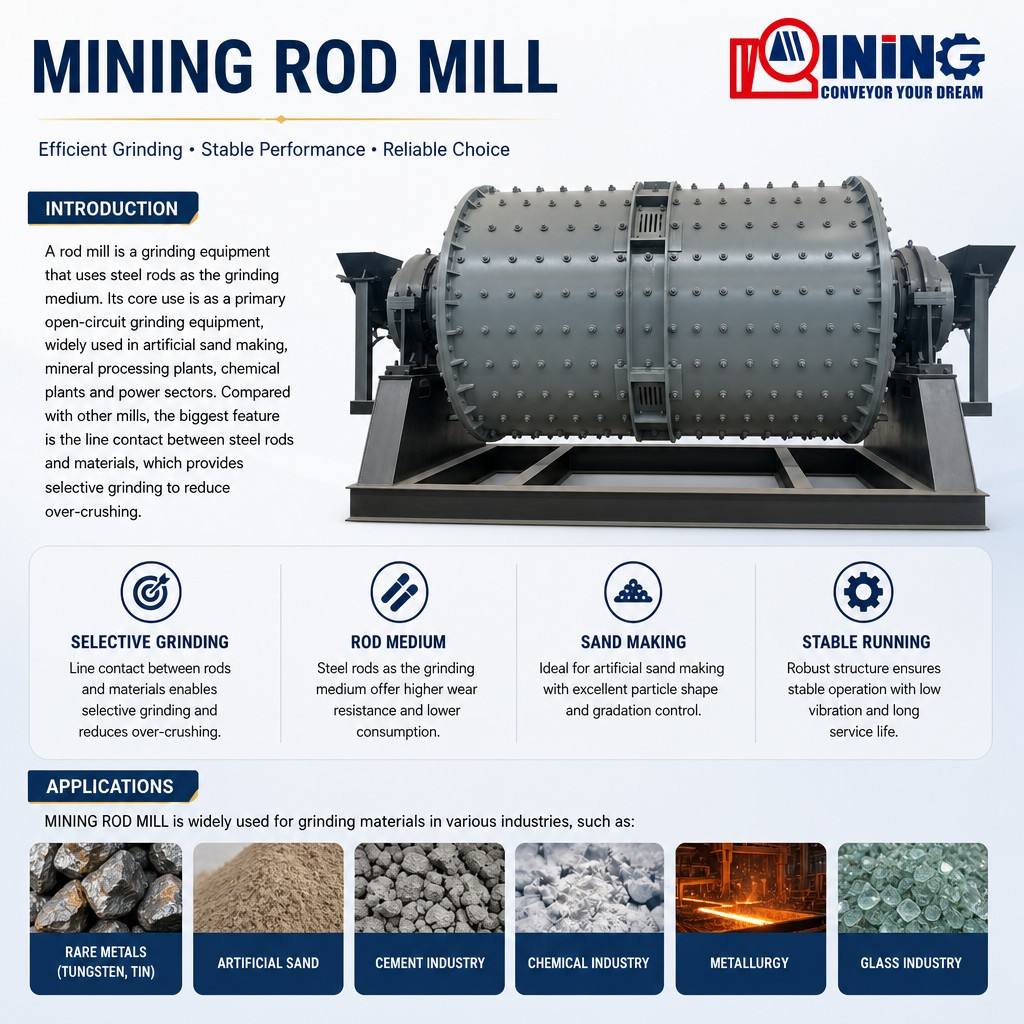
This is the rod mill's superpower. Because rods provide line contact rather than point contact, larger particles get caught between the rods and are crushed first, while finer particles are protected. This selective grinding action dramatically reduces over-grinding and the generation of unwanted slimes.
2. Uniform Particle Size Distribution
Rod mills produce a narrower, more consistent particle size distribution compared to ball mills operating under the same conditions. This uniformity is critical for downstream processes like gravity separation, magnetic separation, and flotation.
3. Lower Power Consumption
Because rods operate at lower peripheral speeds and do not cascade as vigorously as balls, rod mills consume less power per ton of product. The grinding action is more efficient for coarse fractions, which practically corresponds to lower energy consumption.
4. Lower Steel Consumption
With less void space in a rod charge compared to any other grinding media, rod mills achieve higher grinding efficiency and lower steel consumption.
5. Excellent for Gravity and Magnetic Separation
For processing tungsten, tin, rare earth metals, and other minerals recovered by gravity or magnetic separation, rod mills are highly recommended to prevent excessive pulverization of valuable minerals. The uniform grain-size composition from rod milling produces higher dissociation of magnetite and better magnetic separation results.
Rod Mills vs. Ball Mills: Which One Do You Need?
Understanding the difference between these two mills isn't academic—it directly impacts your recovery rates and operating costs.
| Feature | Rod Mill | Ball Mill |
|---|---|---|
| Grinding medium | Steel rods | Steel balls |
| Contact type | Line contact | Point contact |
| Product | Coarse, uniform, minimal fines | Fine powder |
| Over-grinding | Low—naturally avoids slimes | Higher—can generate excess fines |
| Filling rate | 35%-45% | 40%-50% |
| Best for | Coarse grinding, primary stage, gravity recovery | Fine grinding, regrinding |
| Product size range | 300 μm to 50 mm | Typically < 100 μm |
When to Choose a Rod Mill
✅ Choose a rod mill when:
Your target product is in the coarse to medium range (300 μm to 50 mm)
You need a uniform particle size with minimal fines
You're processing ore for gravity or magnetic separation
You want lower power and steel consumption
You're designing a rod mill–ball mill circuit where the rod mill does the coarse grinding first
When to Choose a Ball Mill
✅ Choose a ball mill when:
You need very fine grinding (sub-100 μm)
Your downstream process requires fine powder (flotation, leaching)
You're doing regrinding of concentrates
Key Applications of Rod Mills
1. Mineral Processing — Primary Grinding
In many concentrators, the rod mill serves as the first stage of grinding before the ball mill. The rod mill takes crushed ore (typically up to 50 mm) and grinds it down to around 1-3 mm, providing a uniform feed to the ball mill that improves overall circuit efficiency.
For tungsten, tin, rare earth metals, and other gravity-recovered ores, rod mills are essential because they liberate valuable minerals without creating excessive fines that would be lost to tailings.
2. Manufactured Sand Production
Rod mills have been used for sand making since at least 1925. A properly designed center discharge rod mill is the most efficient and economical machine for manufacturing specification sand.
Applications include:
Processing quartz sand, feldspar, dolomite
Producing artificial sand from river pebbles and other materials
Manufacturing abrasives and refractories
3. Glass and Ceramics Industries
Rod mills are widely used in the glass, ceramics, and building materials industries for grinding materials where product uniformity is critical. For processing quartz sand, dolomite, and monazite, rod mills can be equipped with magnetic separators to remove iron.
4. Coal Water Slurry Preparation
Rod mills are particularly suitable for coarse grinding applications in the coal chemical industry for coal-water slurry preparation.
Critical Design Considerations
Rod Quality Matters
Bent rods cause tangling—and tangled rods stop production. Only use high-quality, heat-treated rods. Replace rods when they wear down to about 25 mm in diameter.
Length-to-Diameter Ratio
The ratio of rod length to mill diameter should be greater than 1.25 to avoid the risk of rod tangling. The recommended ratio is 1.4 to 1.6.
Operating Speed
Rod mills should typically run at 60% to 70% of critical speed. Running too fast causes rods to be thrown rather than tumbled, reducing efficiency. Running too slow reduces throughput.
Open Circuit Operation
Rod mills are normally operated in open circuit—unlike ball mills which are typically closed circuit. This makes them simpler to operate and maintain.
Common Specifications (For Reference)
| Parameter | Typical Range |
|---|---|
| Feed size | Up to 50 mm |
| Product size | 300 μm to 1-3 mm |
| Reduction ratio | 15:1 to 20:1 |
| Speed | 50%-65% of critical speed |
| Rod diameter | 25 mm to 150 mm |
Limitations to Consider
While rod mills offer many advantages, they do have limitations:
Lower productivity than ball mills of the same specification
Not suitable as fine grinding equipment
Adding rods requires machine halt, contributing to higher labor intensity
Not ideal for very fine grinding applications
Conclusion: The Right Tool for the Right Job
Here's the bottom line:
If you need coarse, uniform product with minimal fines—for gravity recovery, sand making, or primary grinding—choose a rod mill.
If you need fine powder—choose a ball mill.
They're not competitors; they're partners. In many plants, they work together: the rod mill does the coarse grinding, and the ball mill finishes the job.
Understanding the difference isn't academic—it's about making the right investment for your specific ore and your specific recovery goals. A well-selected rod mill can significantly improve your circuit efficiency, reduce your operating costs, and boost your recovery rates.
Ready to discuss your grinding circuit?
Contact us today to discuss your ore characteristics and production targets. Our team of grinding experts can help you select the right equipment for your specific application.