
Introduction
For decades, the mining and mineral processing industry has relied on gear-driven ball mills as the standard for ore grinding. But there’s a quieter, simpler, and more cost-effective alternative that’s gaining serious traction: the tire-driven ball mill.
Also known as a tyre ball mill, this innovative design replaces the traditional large ring gear, pinion, and complex lubrication systems with a simple, rugged tire drive system. The result? Lower maintenance costs, reduced noise, faster delivery times, and energy savings that directly impact your bottom line.
Here’s why tire-driven ball mills are becoming the preferred choice for grinding circuits worldwide.
How a Tire-Driven Ball Mill Works
The operating principle of a tire-driven ball mill is fundamentally the same as any ball mill: a rotating cylindrical drum lifts grinding media (steel balls, ceramic balls, or rods) and cascades them onto the material to achieve size reduction. The difference is in how the drum is driven.
In a traditional gear-driven mill, a large cast ring gear mounted on the drum is driven by a small pinion gear connected to the motor. This system requires precise alignment, constant lubrication, and regular maintenance of expensive gears and bearings.
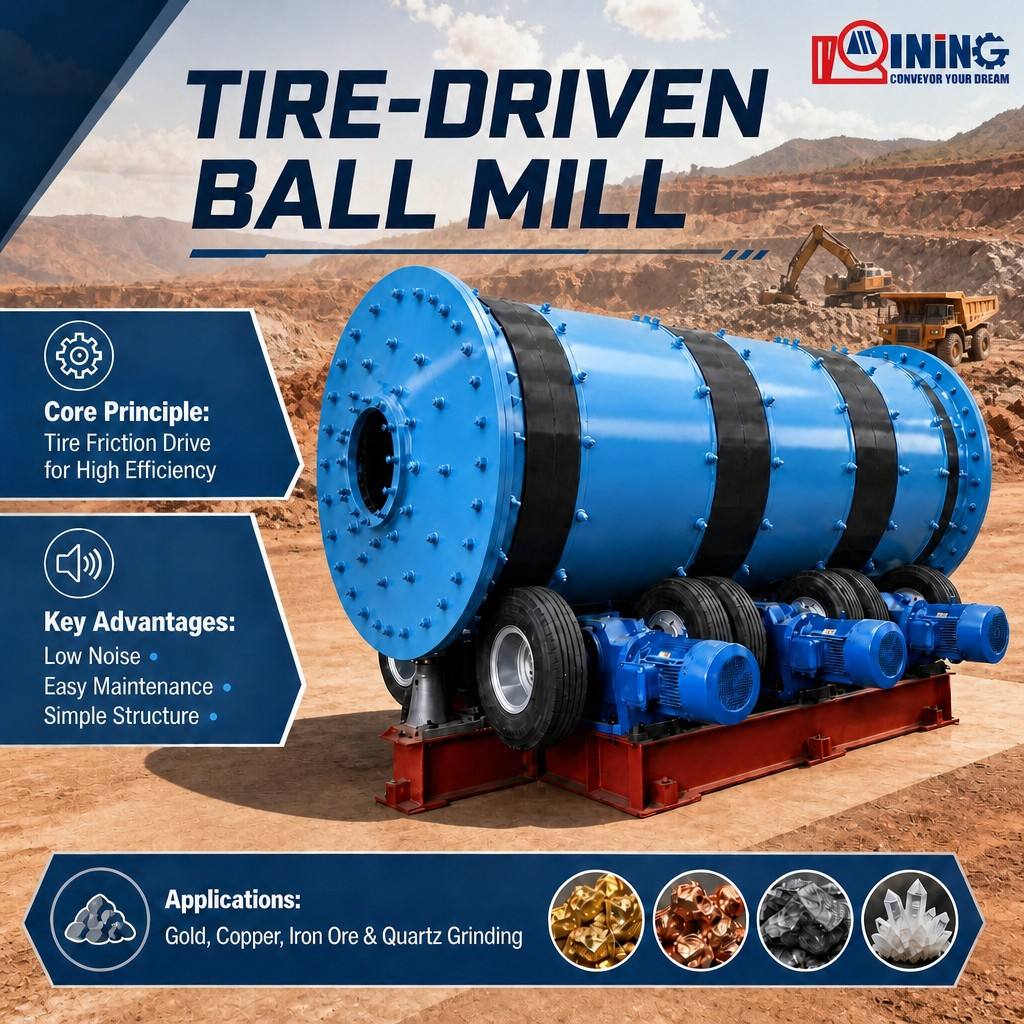
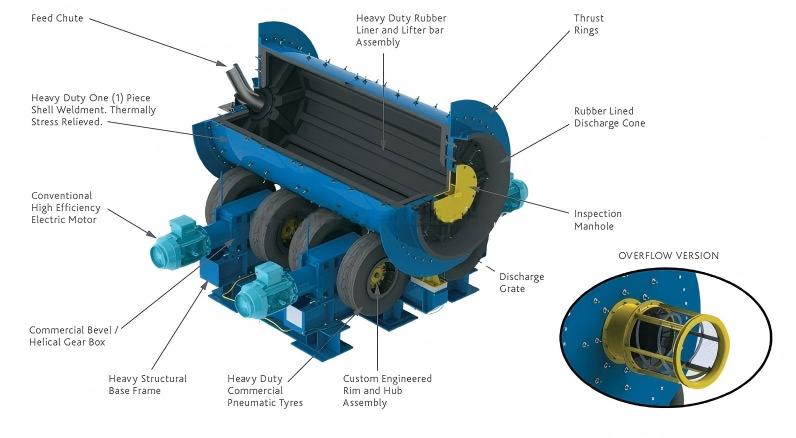
In a tire-driven ball mill, the drum rests on and is driven by rubber tires mounted on independent drive units. Motor-powered tires (instead of gears) rotate the drum at 15–25 RPM, lifting materials and grinding media via centrifugal force for cascading impact. The friction between the tires and the drum shell transmits the driving force, eliminating the need for ring gears, pinions, and their associated lubrication systems.
This simple yet elegant design is the foundation of all the advantages that follow.
Key Advantages of Tire-Driven Ball Mills
1. Lower Maintenance Costs
Traditional gear-driven mills require regular lubrication, alignment checks, and replacement of expensive gears and bearings. Tire-driven mills eliminate these components entirely. By removing the large ring gear, bearings, and lubrication systems, tire-driven ball mills significantly reduce maintenance costs and downtime.
2. Reduced Power Consumption
The tire drive system minimizes mechanical friction losses, resulting in 10–15% lower power consumption compared to gear-driven mills. Over the lifetime of a mill, these energy savings can translate into hundreds of thousands of dollars in reduced operating costs.
3. Faster Delivery and Lower Installation Costs
Tire-driven mills have simpler foundations and structural requirements. They minimize the use of concrete, use steel structure bases, and can be installed more quickly than traditional gear-driven mills. The absence of large cast components also means shorter manufacturing lead times.
4. Quieter Operation
The elimination of metal-to-metal gear contact dramatically reduces noise levels. Gear drives produce significant noise from gear mesh; tire drives operate much more quietly, creating a better working environment for plant personnel.
5. Lower Foundation Requirements
Traditional mills require heavy, reinforced concrete foundations to support the weight and vibration of large gear drives. Tire-driven mills are lighter and distribute loads more evenly, requiring simpler, less expensive foundations.
6. Standard, Off-the-Shelf Components
Unlike the custom cast gears required for traditional mills, tire-driven mills use commercial heavy truck tires that can be easily sourced locally. This means faster replacements and reduced downtime when maintenance is needed.
7. Flexible Liner Options
Due to the tire drive method, tire-driven ball mills typically use lightweight, low-noise, high-wear-resistance rubber liners. However, manganese steel liners can also be used depending on the application. Rubber liners reduce energy consumption, extend replacement cycles, and improve operation efficiency.
Grinding Media Options
Tire-driven ball mills are versatile and can accommodate various grinding media types:
| Media Type | Application |
|---|---|
| Steel balls | Standard ore grinding, most common |
| Ceramic grinding balls | Applications requiring low iron contamination |
| Steel rods | Rod mill applications for coarser grinding |
| Pebbles | Specialized applications |
Applications
Tire-driven ball mills are mainly suitable for dry and wet grinding in power and mining industries. They are widely used in:
Iron ore processing
Gold ore grinding
Copper ore processing
Zinc ore grinding
Quartz sand processing
Tungsten carbide grinding
The BHT Tyre-Driven Ball Mill range spans from 1 meter diameter up to 2.5 meters diameter, typically forming part of a complete lime slaking or grinding package.
Real-World Adoption
The tire-driven ball mill is not a niche product – it's being adopted by major mining operations around the world.
Bulk Handling Technologies (BHT) has steadily expanded its Tyre-Driven Ball Mill range, delivering reliable grinding solutions for customers across multiple gold and rare earth processing applications. They are currently assembling ball mills for clients in Western Australia and fabricating additional mills for an African gold mining customer.
Sepro Mineral Systems offers a complete line of Sepro Tyre Drive Grinding Mills, utilizing the Sepro Pneumatic Tyre Drive System (SPTD) – a time-tested, rugged, and low-maintenance solution proven in numerous difficult mineral processing applications. Their mills come with variable frequency drives, touch-screen HMIs, and tire pressure monitoring systems to protect against costly downtime.
Earth Technica has developed unique tire-driving-type “New Rod Mills” and “New Ball Mills” featuring lower power consumption, easier maintenance, and low noise levels.
Specifications Overview
Tire-driven ball mills are available in a wide range of sizes:
| Model | Drum Diameter (mm) | Capacity (t/h) | Power (kW) |
|---|---|---|---|
| TY-1200 | 1200 | 10-15 | 55 |
| TY-1400 | 1400 | 20-25 | 90 |
| TY-1600 | 1600 | 30-35 | 132 |
| TY-1800 | 1800 | 40-45 | 185 |
| TY-2000 | 2000 | 45-50 | 220 |
Typical feed size: ≤25mm; discharge size: 45-150μm
Comparison: Tire-Driven vs. Gear-Driven
Conclusion
Tire-driven ball mills represent a smart, practical evolution in grinding technology. By replacing expensive, maintenance-intensive gear drives with simple, rugged rubber tire systems, they deliver:
10-15% lower energy consumption
Quieter operation
Faster delivery and installation
Simpler foundations
Easier access to spare parts
Whether you're processing gold ore, grinding cement clinker, or slaking lime, the tire-driven ball mill offers a compelling alternative to traditional gear-driven mills. It's proven, reliable, and increasingly the choice of mining operations worldwide.
Ready to explore how a tire-driven ball mill could improve your grinding circuit? Contact our team to discuss your specific application and capacity requirements.