
Introduction: The Overlooked Workhorse of Precision Grinding
When most people think of ball mills, they picture massive continuous machines roaring day and night, processing thousands of tons of ore without pause. And for large-scale operations, that's exactly what works.
But there's another type of ball mill that operates on a completely different principle — one that offers something continuous mills simply cannot match: precise, batch-by-batch quality control.
Enter the batch ball mill (also known as the intermittent ball mill or ceramic ball mill).
This isn't the machine you choose for high-volume production. It's the machine you choose when product purity matters, when particle size consistency is critical, and when flexibility is more valuable than sheer throughput.
What Is a Batch Ball Mill?
A batch ball mill is a grinding machine that processes materials in discrete batches rather than continuously. Instead of feeding material in and letting it flow out continuously, you load a specific quantity of material and grinding media into the mill, run it for a set time, and then discharge the entire batch at once.
This is why it's often called a "one-batch-at-a-time" mill.
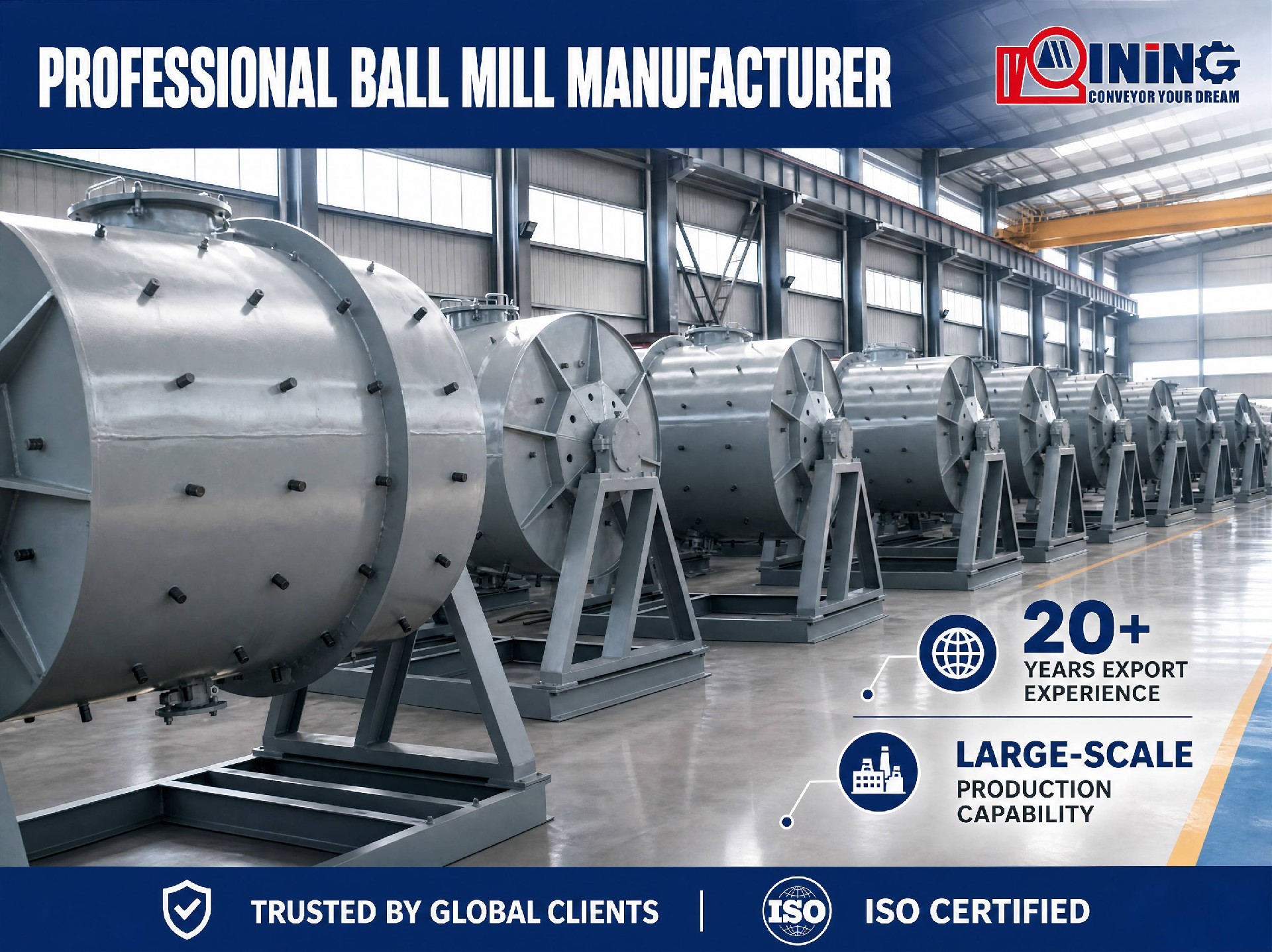
Batch ball mills are horizontal, cylindrical rotating devices typically driven by an external gear. They are usually divided into two grinding chambers: the first for coarse grinding and the second for fine grinding. Materials enter through a hollow shaft, are ground by steel balls or ceramic media, and discharged through a grate plate once the desired fineness is achieved.
Because they can be lined with different materials — including ceramic, silica, rubber, or metal — they are also commonly called ceramic ball mills.
How It Works: The "Load, Grind, Discharge" Cycle
The working principle of a batch ball mill is straightforward but highly effective:
Load: A measured batch of material and grinding media is loaded into the mill.
Rotate: The horizontal cylinder rotates, and the grinding media (steel balls or ceramic balls) are lifted to a certain height by centrifugal force.
Impact and Grind: The balls fall and impact the material, crushing and grinding it through a combination of impact, attrition, and extrusion.
Discharge: After a predetermined grinding time — anywhere from minutes to hours — the entire batch is discharged.
The key difference from continuous mills? In a continuous mill, the grinding time is determined by the flow rate. In a batch mill, you control the grinding time precisely. Want a finer product? Just run it longer. Need a coarser product? Stop it sooner. This level of control is simply not possible with continuous grinding.
Why Choose a Batch Ball Mill? 5 Compelling Advantages
1. Unmatched Particle Size Control
This is the single biggest advantage of batch ball mills. Because you control the grinding time directly, you can achieve extremely uniform particle size distribution from batch to batch. Dry grinding can produce ultra-fine powder with fineness ranging from 1000 to 16000 mesh. For applications where consistency is everything — ceramics, pigments, advanced materials — this is critical.
2. Zero Cross-Contamination Between Batches
In a continuous mill, the tail end of one batch mixes with the head end of the next. In a batch mill, each batch is completely isolated. After discharging, the mill can be cleaned before the next batch is loaded. This is essential for industries that process multiple formulations or require strict purity standards.
3. Flexible for Small and Medium Production
Batch ball mills are ideal for small-batch, high-variety production. You can run 50 kg of one material, clean the mill, and run 200 kg of a completely different material the next day. This flexibility makes them indispensable in laboratories, pilot plants, and specialty manufacturing.
4. Dry and Wet Grinding in One Machine
Batch ball mills can handle both dry and wet grinding in the same equipment. Wet grinding is common in the ceramics industry, while dry grinding is preferred for certain minerals and chemicals. Having both options in one machine adds significant value.
5. Lower Investment, Lower Operating Costs
Batch ball mills typically require less capital investment than continuous mills of comparable capacity. They are also more energy-efficient than many continuous alternatives, with simpler structures that are easier and cheaper to maintain.
Applications: Where Batch Ball Mills Excel
Batch ball mills are not a replacement for continuous mills — they serve a different purpose. Here's where they shine:
Ceramics Industry
This is perhaps the most common application. Batch ball mills are used to grind feldspar, quartz, clay, and glaze materials to extremely fine and uniform particle sizes. The ability to control particle size precisely is critical for ceramic quality.
Mining and Mineral Processing
For processing gold, copper, iron, and other ores, batch ball mills are used in laboratories, pilot plants, and small-scale operations where precise grinding control is needed. They are also used for grinding tungsten, tin, and rare earth metals.
Building Materials and Refractories
Batch ball mills grind materials for cement, silicate products, new building materials, and refractories. The consistent particle size ensures product quality and performance.
Chemical and Pharmaceutical Industries
For grinding chemical raw materials and pharmaceutical ingredients, the batch process allows strict quality control and batch traceability.
Glass Industry
Batch ball mills are used to grind silica, soda ash, and other glass-making materials to the required fineness.
Research and Development
In laboratories and R&D facilities, batch ball mills are essential for testing new materials, developing formulations, and conducting small-scale trials.
Technical Specifications: What to Look For
Batch ball mills come in a wide range of sizes. Here's a quick reference for common models:
| Model | Batch Load Capacity (tons/time) | Rotating Speed (r/min) | Power (kW) |
|---|---|---|---|
| 600×700 | 0.05 | 50 | 2.2-4 |
| 800×600 | 0.075 | 42 | 3-5.5 |
| 900×1200 | 0.2 | 38.5 | 5.5-11 |
| 1300×1500 | 0.5 | 33 | 18.5-37 |
| 1500×1800 | 1.2 | 28.5 | 30-75 |
| 1800×2000 | 1.5 | 24 | 45-115 |
| 2600×2800 | 5 | 16.5 | 115-310 |
| 3000×3800 | 10 | 14.5 | 280-570 |
| 3200×4600 | 15 | 13.5 | 380-800 |
Note: Power requirements vary based on liner material (ceramic, silica, rubber, or metal) and the specific material being ground.
Batch Ball Mill vs. Continuous Ball Mill: Which One Do You Need?
| Feature | Batch Ball Mill | Continuous Ball Mill |
|---|---|---|
| Operation mode | Discrete batches | Continuous feed and discharge |
| Particle size control | Excellent — controlled by grinding time | Good — controlled by feed rate and classification |
| Batch-to-batch consistency | High — each batch is isolated | Lower — mixing between batches |
| Cross-contamination risk | Low — can be cleaned between batches | Higher — residual material in the system |
| Production volume | Small to medium | Medium to large |
| Flexibility | High — easy to switch materials | Low — difficult to change formulations |
| Investment cost | Lower | Higher |
| Best for | Quality-focused, small-batch, high-variety production | High-volume, single-product production |
Conclusion: Choose the Right Tool for the Job
The batch ball mill is not a competitor to the continuous ball mill — it's a complementary tool for a different set of requirements.
If you're processing thousands of tons of ore per day and need maximum throughput, choose a continuous mill.
But if you need precise particle size control, zero cross-contamination, flexibility to switch between materials, and batch-by-batch quality assurance, the batch ball mill is your machine.
Whether you're grinding feldspar for ceramics, ore for mineral processing, or raw materials for chemicals and pharmaceuticals, the batch ball mill delivers consistent, high-quality results that continuous mills simply cannot match.
Ready to discuss your grinding requirements?
Contact our team of experts to find the right batch ball mill for your specific application. We'll help you select the model, liner type, and grinding media that delivers the results you need.