
From limestone to marble, discover how Raymond mills deliver consistent, fine powder with low operating costs.
Introduction: The Backbone of Industrial Powder Production
If you work in mining, construction, chemicals, or metallurgy, you know that fine powder grinding is a critical step in many production processes. Whether you're processing limestone for cement, calcite for fillers, or gypsum for wallboard, the quality and consistency of your final powder directly impact your product's performance and your bottom line.
Among the many grinding mills available, the Raymond mill has stood the test of time as one of the most reliable, efficient, and versatile choices for producing fine powders. Since its invention in the late 19th century, it has evolved into a modern, high-performance machine that continues to be the workhorse of countless powder processing plants worldwide.
In this guide, we'll explain what a Raymond mill is, how it works, its key advantages, and how to choose the right one for your material.
What Is a Raymond Mill?
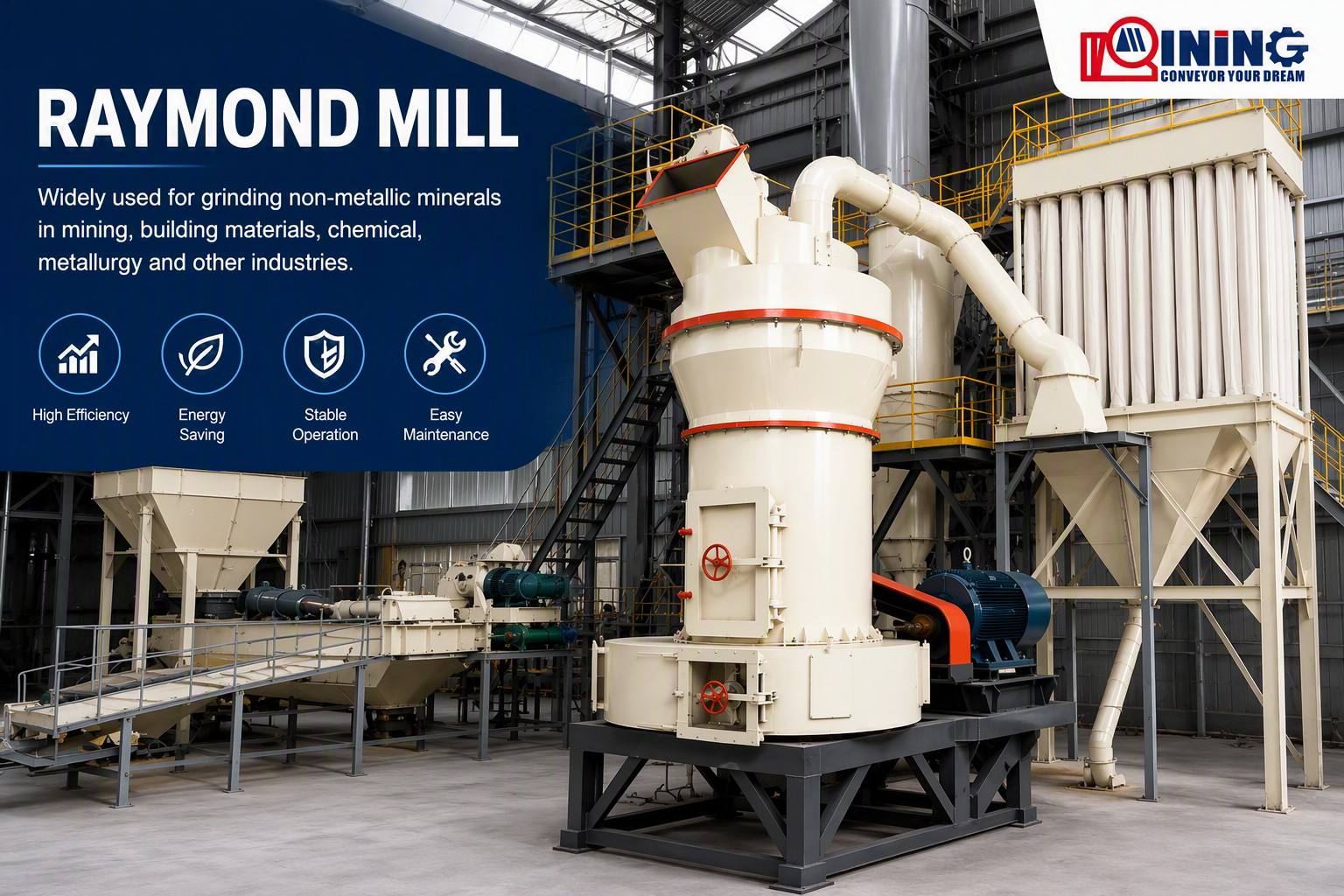
A Raymond mill is a type of pendulum pulverizer that uses rotating rollers pressed against a grinding ring to crush and grind materials into fine powder. The ground powder is then classified by an air separator, with coarse particles returned to the grinding chamber for further processing.
Modern Raymond mills are highly refined machines featuring:
Overlapping multi-stage sealing for dust-free operation
High-efficiency centrifugal fans for stable airflow
Advanced classifiers for precise particle size control
Integrated dust collection systems for environmental compliance
The result is a compact, efficient grinding system capable of producing powders from 80 to 325 mesh (and even finer with specialized configurations).
How Does a Raymond Mill Work?
The working principle of a Raymond mill is elegant in its simplicity:
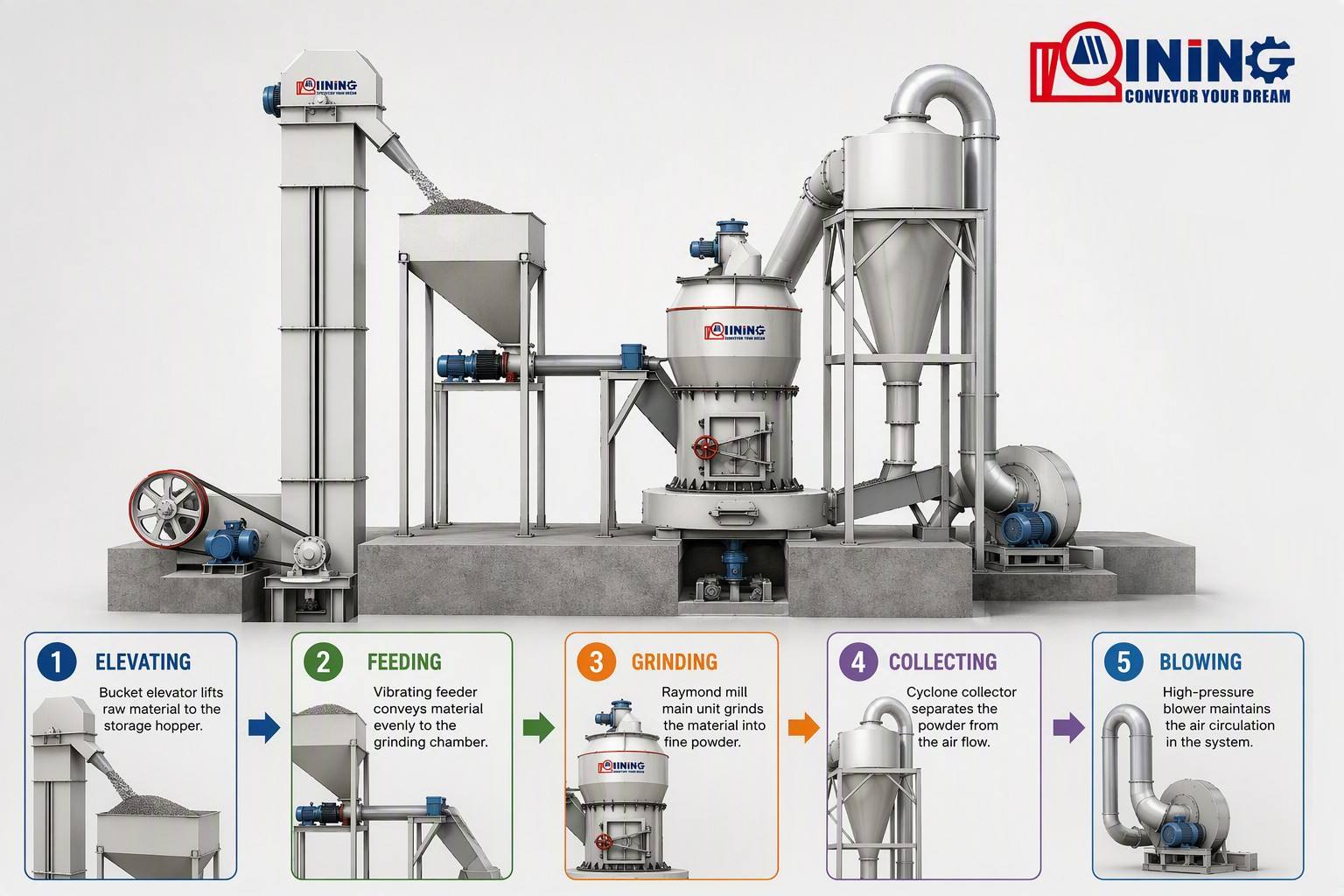
Feeding: Raw material is fed into the grinding chamber by an electromagnetic vibrating feeder.
Grinding: The material is scooped up by a shovel blade and fed between the grinding rollers and the grinding ring. The rollers rotate around a central shaft while also spinning on their own axes, crushing the material by both centrifugal force and grinding pressure.
Classification: An upward airflow from the fan carries the ground powder into the classifier. Fine particles pass through, while coarse particles fall back for regrinding.
Collection: The fine powder is collected by a cyclone separator and discharged through a discharge valve. The entire system operates under negative pressure, ensuring no dust escapes.
Key Advantages of Raymond Mills
1. Adjustable Fineness
The classifier can be easily adjusted to produce powders ranging from 80 to 325 mesh, making it suitable for a wide range of applications.
2. High Efficiency, Low Energy Consumption
Compared to ball mills, Raymond mills consume less power per ton of product and occupy a much smaller footprint. The closed-loop grinding and classification system ensures that only sufficiently fine particles exit the mill, avoiding over-grinding.
3. Excellent Dust Control
The entire system operates under negative pressure, and the connection between the main unit and the cyclone is sealed with a flexible connection. This eliminates dust leakage and creates a clean, safe working environment.
4. Wide Material Adaptability
Raymond mills can process over 280 types of non-flammable and non-explosive materials with Mohs hardness below 7 and moisture content below 6%, including:
Limestone, calcite, dolomite
Barite, gypsum, talc
Mica, marble, feldspar
Bentonite, kaolin, and more
5. Simple Structure, Easy Maintenance
With a compact design and few moving parts, Raymond mills are easy to operate and maintain. The grinding rollers and ring are the main wear parts, and they can be replaced quickly without extensive downtime.
Common Applications
Raymond mills are widely used in:
| Industry | Typical Materials |
|---|---|
| Construction & Building Materials | Limestone, gypsum, cement clinker |
| Chemical Industry | Barite, talc, bentonite, kaolin |
| Metallurgy | Bauxite, manganese ore, iron ore |
| Agriculture | Phosphate rock, dolomite |
| Environmental Protection | Desulfurization limestone powder |
How to Choose the Right Raymond Mill
When selecting a Raymond mill, consider the following factors:
Material Hardness: The mill is suitable for materials with Mohs hardness below 7.
Moisture Content: Feed material should have less than 6% moisture to prevent clogging.
Target Fineness: Determine the required mesh size – this will dictate the classifier setting and mill configuration.
Capacity Requirements: Raymond mills are available in various sizes, from small laboratory models to large production units processing up to 50 tons per hour.
Auxiliary Equipment: A complete system typically includes a jaw crusher, bucket elevator, feeder, classifier, cyclone, and dust collector.
Maintenance Tips for Long Service Life
Lubrication: Regularly grease the grinding roller bearings and central shaft.
Wear Parts: Inspect the grinding rollers and ring for wear; replace when the output drops or fineness becomes inconsistent.
Classifier Adjustment: Fine-tune the classifier to maintain the desired product fineness.
Airflow Balance: Ensure the fan and pipeline system are leak-free for efficient powder transport.
Regular Cleaning: Remove accumulated dust from the system to prevent blockages.
Conclusion: A Smart Investment for Powder Producers
The Raymond mill has earned its place as a tried-and-true solution for fine powder grinding. Its combination of high efficiency, precise fineness control, low maintenance, and environmental friendliness makes it an excellent choice for businesses of all sizes.
Whether you're producing fillers, processing minerals, or manufacturing building materials, investing in a quality Raymond mill can improve your product consistency, reduce your operating costs, and help you meet the most demanding specifications.
Ready to upgrade your powder grinding process? Contact our team to discuss your material and production requirements – we'll help you select the right Raymond mill for your application.